
Baby Food Category Feasibility & Optimization Case Study
Introduction
The global baby food market is growing steadily, increasing from USD 78.31 billion in 2024 to USD 82.43 billion in 2025, at a CAGR of approximately 5.3% [1]. Reflecting this trend, the UAE baby food market is expected to grow faster, expanding from USD 3.20 billion in 2024 to USD 5.38 billion by 2033, at a CAGR of 5.99%.
Common drivers of this growth, observed across global and regional markets including the UAE, include the rising participation of women in the workforce, evolving urban lifestyles, and increasing nutritional awareness among parents seeking to meet the dietary and developmental needs of their children .
As the baby food market expands, sustaining a reliable supply and effective supplier partnerships becomes increasingly important. This presentation evaluates supplier performance and category structure and offers pragmatic recommendations to strengthen operational, inventory, and supplier management practices.
Dataset Summary
- Original dataset, which contained 3,176 records across 49 fields, sourced from a retailer/distributor in the GCC region, has been split into 2 sub-datasets.
- Two dataset’s have been derived from the original dataset:
- Dataset A contains 3,162 values across 38 fields.
- Dataset B contains 968 values across 35 fields.
- 18 fields removed and 4 new fields added to support meaningful business analysis.
- The dataset(s) are primarily numerical, enabling performance-driven evaluation.
The analysis uses two complementary datasets: one to establish overall market patterns and category behaviour, and a second to evaluate top-performing sub-families using consistent, high-quality data. This is because data completeness and integrity were consistently violated during data cleaning, due to a bug in the upstream collection process. Hence, clear distinctions will be made throughout the analysis to ensure no confusion between overall market patterns and sub-family performance.
Data Field Definitions
The dataset includes several retail-specific fields; the following definitions are provided to ensure clarity and consistency for all audiences.
- Rebate: A payment from a supplier to a retailer after sales or performance targets are met.
- Gross Sales: A commercial adjustment reflecting supplier support or contractual sales terms.
- Product Group Name (PG Name): A grouping of products based on brand, contract, or commercial agreement.
- Sub-Family: A product category that groups items by usage or stage in the baby feeding lifecycle.
- Asset Name: A label describing a product’s in-store role or lifecycle status (e.g., Basic, Organic, End-of-Life).
- Purchase: The quantity or value of products bought by the retailer from suppliers.
- Quantity Sold (Qnty Sold): The number of units actually sold to customers.
Dataset A: KPI Insights and Implications
Dataset A is used selectively to support targeted supplier and item-level performance insights. Given its broader coverage across sub-families and transactional records, analysis is deliberately focused on a limited number of high-impact charts to avoid over-aggregation and ensure clarity of interpretation. This approach prioritises decision-relevant insights over excessive visualisation while preserving analytical accuracy.
The suppliers are evaluated across these metrics:
- Quantity Sold
- E-commerce Sales
- Profitability
- Sales
Top 10 Suppliers: Insights & Implications:
Context
This analysis focuses on the Top 10 suppliers within the baby food category, assessed across multiple commercial and operational dimensions rather than a single performance metric. The objective is to understand not only who the top suppliers are, but why they perform the way they do and what that implies for category, supplier, and inventory decision-making.
Insights:
- Consistent top-tier performance by a limited set of suppliers
Two Suppliers were consistently ranked at or near the top across multiple core performance indicators, including:
- Total Sales
- Quantity Sold
- E-commerce Sales
- Overall Profitability
Their repeated presence at the top across these dimensions suggests a balanced and resilient supplier profile, rather than strength driven by a single metric. In practical terms, these suppliers demonstrate an ability to:
- Generate volume without materially sacrificing profitability
- Perform effectively across both physical retail and e-commerce channels
- Maintain commercial relevance across different sales levers
Notably, both suppliers show near parity across all four metrics, indicating that neither relies disproportionately on discount-led volume, channel bias, or isolated high-margin SKUs. This balance reduces risk and makes their performance more sustainable over time.
- High sales volume does not automatically equate to profitability or digital strength
A key finding from the analysis is that high volume alone is not a reliable indicator of overall supplier quality.
Several suppliers appear in the Top 10 when ranked by:
- Quantity Sold, or
- Total Sales
However, these same suppliers rank significantly lower when evaluated on:
- Profitability, and/or
- E-commerce Sales
This divergence highlights that:
- Strong physical retail throughput does not necessarily translate into margin efficiency
- High-volume suppliers may rely on lower margins, higher promotional intensity, or cost-heavy operational models
- Some suppliers struggle to convert traditional retail strength into effective digital performance
The underlying drivers of this variation include:
- Differences in margin structures across suppliers
- Uneven channel effectiveness (offline vs online)
- Varying cost bases, promotional dependencies, and pricing strategies
In short, volume leadership can mask structural weaknesses if viewed in isolation.
Implications:
- Supplier performance varies significantly depending on the metric used
The analysis makes it clear that supplier rankings change materially based on which performance lens is applied. A supplier that appears “top-tier” on volume may be mid- or low-performing when profitability, e-commerce effectiveness, or operational reliability are considered.
This creates a risk if decision-making relies too heavily on:
- Single-metric rankings
- Volume-led supplier assessments
- Sales contribution alone
Such an approach can lead to:
- Overexposure to suppliers that are operationally or commercially inefficient
- Underinvestment in suppliers that deliver balanced, high-quality performance across multiple dimensions
- Need for a multi-dimensional supplier evaluation framework
The findings strongly support the adoption of a multi-dimensional supplier performance framework, rather than isolated KPI tracking.
Under this framework:
- Sales and Quantity metrics are assessed alongside
- Profitability, E-commerce effectiveness, and
- Operational and qualitative indicators
This approach allows decision-makers to understand trade-offs between volume, margin, and channel performance, rather than assuming they move together.
- Role of complementary qualitative and operational indicators
To further strengthen supplier evaluation, quantitative metrics should be complemented by operational and qualitative indicators, such as:
- On-time delivery performance
- Service reliability
- Execution consistency
These factors play a critical role in:
- Reducing supply risk
- Improving inventory stability
- Supporting consistent category performance
Importantly, these indicators reinforce the multi-dimensional framework by capturing elements that are not visible in sales or margin data alone but materially impact long-term performance.
- Reduced reliance on individual metrics leads to better decisions
By integrating multiple performance dimensions and qualitative indicators into a unified framework, the retailer can:
- Avoid over-reliance on any single metric (e.g., volume or sales)
- Make more informed supplier selection, ranging, and investment decisions
- Better align supplier strategy with broader category and lifecycle objectives
Ultimately, this approach supports more balanced, resilient, and strategically aligned supplier management, particularly in a category as sensitive and lifecycle-dependent as baby food.
Dataset B: KPI Insights & Implications
Dataset B is designed to provide a high-level, structural view of the baby food market by analysing SKU coverage, category mix, and broad commercial patterns. Given its role as a directional dataset, analysis focuses on charts that highlight overall trends and relationships rather than granular performance diagnostics. This ensures a clear understanding of what is happening across sub-families without over-interpreting item-level detail.
There are 5 analytic approaches when analysing SKU coverage, category, and inventory:
- Sum of Sales by Sub-Family: Shows the overall sales contribution of each top-performing baby food sub-family.
- Fees, Rebate, & GSF Comparison: Compare Store Fees, HO Fees, GSF, and Rebate across top-performing sub-families
- Sub-Family Mix by Supplier : Displays total sales contribution of each product group, split across the four baby food sub-families.
- Count of Sub-Family by Asset Name: SKUs from each top-performing sub-family associated with different asset types/ merchandising groups (e.g., basic shelves, health sections, end-of-life, premium zones).
- Comparison between Purchase & Quantity Sold
Sum of Sales by Sub-Family: Insights & Implications
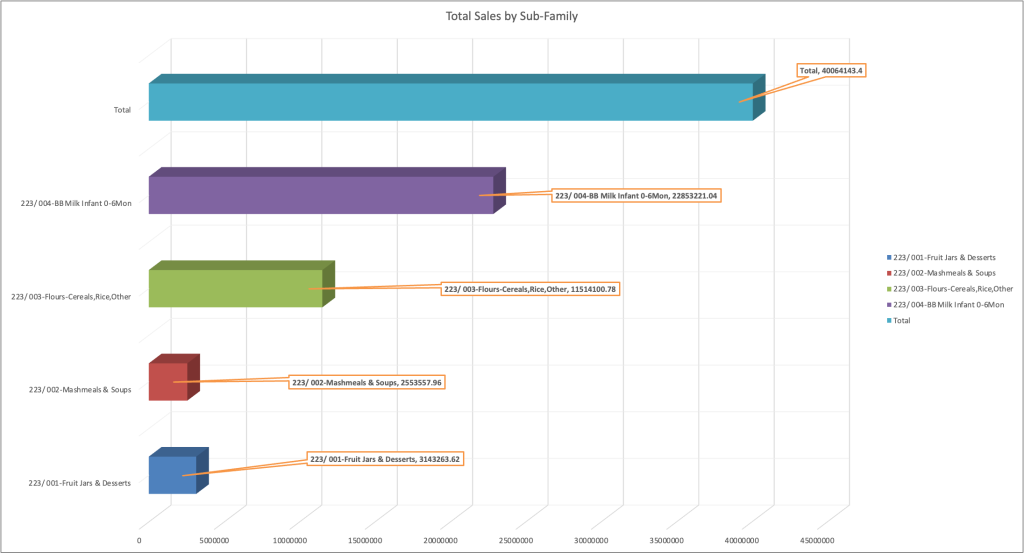
Context and Scope:
This analysis examines sales contribution by sub-family within the baby food category to understand how revenue is distributed across different product groups and infant feeding stages. The objective is to identify revenue anchors, assess portfolio balance, and evaluate whether the category structure supports a diversified, lifecycle-aligned assortment.
Total category sales highlighted in the analysis amount to approximately AED 22.85 million, providing the reference point for understanding concentration and contribution patterns across sub-families.
Insights
- Infant Milk Formula (0–6 months) is the clear revenue anchor
The analysis shows that Infant Milk Formula (0–6 months) is the single largest contributor to total category sales, significantly outperforming all other sub-families.
This sub-family alone accounts for a disproportionately large share of total revenue, effectively anchoring the category’s financial performance. The data indicates a high dependence on one early-stage infant feeding segment, meaning that a substantial portion of category success is tied to demand patterns, availability, and execution within this single sub-family.
While this dominance reflects strong and consistent demand in early infant nutrition, it also introduces concentration risk, as category performance becomes highly sensitive to disruptions, regulatory changes, pricing pressure, or supplier issues affecting this segment.
- Flours, Cereals & Rice form the second-largest revenue base
Following Infant Milk Formula, Flours, Cereals & Rice emerge as the second-largest contributor to sub-family sales.
This sub-family represents the next stage in the infant feeding lifecycle, supporting weaning and early solid food introduction. Its strong contribution confirms that demand extends beyond early formula feeding and that parents transition meaningfully into complementary foods.
However, the revenue gap between Infant Formula and Flours/Cereals remains substantial, reinforcing the top-heavy nature of the category structure rather than a balanced, evenly distributed portfolio.
- Sales are highly concentrated across the top sub-families
Taken together, Infant Formula (0–6 months) and Flours, Cereals & Rice account for the majority of category revenue. The analysis visually and numerically highlights that these two sub-families dominate overall sales performance, together contributing roughly half or more of total category sales.
This concentration indicates that:
- Category performance is driven by a narrow subset of sub-families
- Growth or decline in these segments has an outsized impact on overall results
- Other sub-families currently play a secondary, supporting role rather than acting as meaningful growth engines
The portfolio therefore exhibits a “top-heavy” structure, where a small number of sub-families carry most of the commercial weight.
- Fruit Jars & Desserts and Mash Meals & Soups are marginal contributors
At the lower end of the revenue spectrum, Fruit Jars & Desserts and Mash Meals & Soups contribute relatively small shares of total sub-family sales.
Combined, these sub-families account for less than 25% of total category revenue, positioning them as marginal contributors rather than core revenue drivers. Their limited contribution suggests:
- Lower penetration or frequency of purchase
- Possible underdevelopment in assortment, visibility, or asset support
- Potential misalignment with shopper needs or lifecycle positioning
While these sub-families serve important nutritional and developmental roles, their commercial impact is currently constrained within the overall category structure.
- Overall portfolio indicates a top-heavy category structure
The cumulative insight from the sub-family breakdown is that the baby food category is not evenly balanced across lifecycle stages. Instead, it is heavily weighted toward early-stage feeding solutions, with declining revenue contribution as infants move into later stages of complementary feeding.
This structure increases reliance on a small number of sub-families and limits the category’s ability to:
- Smooth revenue across different infant age brackets
- Reduce exposure to single-segment volatility
- Fully monetise later-stage feeding opportunities
Implications
- Clear investment opportunity and strategic focus
The concentration of revenue creates a clear case for focused, differentiated investment, rather than uniform allocation across all sub-families.
Key strategic priorities emerge:
- Infant Formula and Flours/Cereals should be treated as core revenue drivers, receiving priority in assortment depth, asset allocation, availability, and execution excellence.
- Fruit Jars & Desserts and Mash Meals & Soups require a refined strategy, rather than simple expansion. Their role should be clearly defined—either as lifecycle enablers, trial categories, or targeted growth opportunities—rather than assuming equal commercial importance.
- Investment should align with the infant feeding lifecycle, recognising that different stages warrant different levels of space, range, and operational focus, rather than a one-size-fits-all approach.
- Align category and asset decisions with lifecycle demand
The findings reinforce the importance of aligning category planning, asset deployment, and inventory strategy with how demand evolves across the infant lifecycle.
Early-stage feeding requires:
- High availability
- Strong supplier support
- Robust inventory buffers
Later-stage feeding may require:
- More targeted assortments
- Different merchandising or education-led strategies
- Selective investment rather than scale-driven expansion
This approach supports a more rational, lifecycle-aligned portfolio, reducing inefficiencies and misallocated resources.
- Strengthened supply chain and supplier relationships
The high concentration of sales within a small number of sub-families justifies deeper supplier partnerships, particularly for Infant Formula and Flours/Cereals.
Implications include:
- Stronger collaboration with key suppliers to protect availability and continuity
- Willingness to optimise procurement and inventory practices to reduce stock-out risk
- Acceptance of higher commercial or operational costs where necessary to safeguard core revenue streams
In a category with high dependency on early-stage feeding products, supply reliability becomes a strategic imperative, not just an operational concern.
- Mitigate concentration risk over time
While current performance supports prioritising high-performing sub-families, the analysis also highlights the need to actively manage and mitigate concentration risk.
This does not imply immediate diversification at the expense of core revenue. Instead, it suggests:
- Gradual strengthening of underperforming sub-families where strategically justified
- Selective innovation or assortment refinement to improve later-stage lifecycle monetisation
- Reducing overdependence on a single feeding stage by building a more resilient category mix over time
Overall takeaway
The “Sum of Sales by Sub-Family” analysis reveals a clear, data-driven picture of a baby food category anchored by early-stage feeding solutions, with strong but uneven revenue distribution across sub-families. The implications point toward focused investment, lifecycle-aligned strategy, deeper supplier partnerships, and deliberate management of concentration risk, rather than uniform category expansion.
Fees, Rebate, & GSF Comparison: Insights & Implications
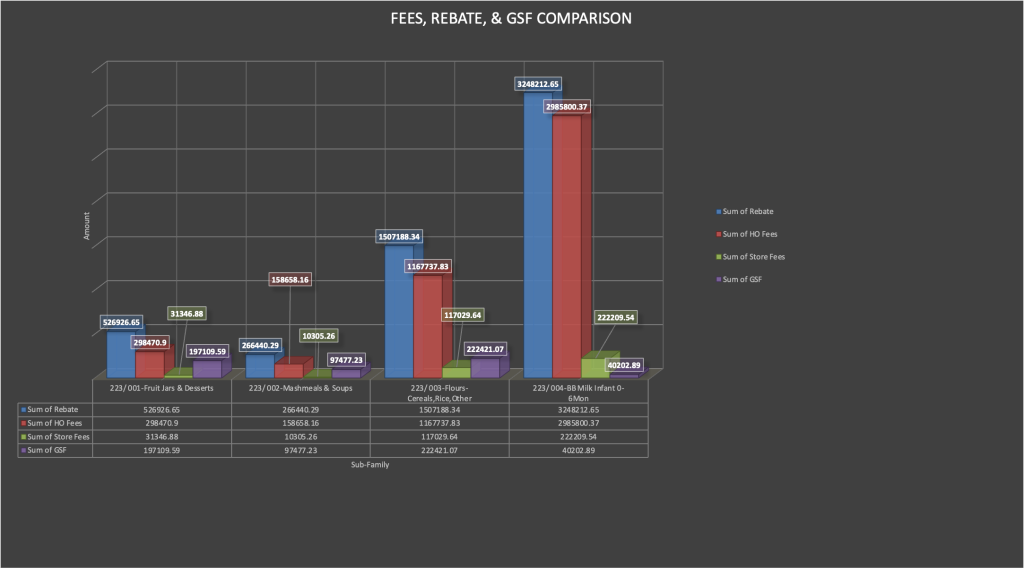
Context and Scope:
This analysis compares three key commercial levers across baby food sub-families:
- Rebates (supplier-funded, back-end commercial support)
- Fees (Head Office fees and Store-level fees)
- GSF (Gross Sales Factor) adjustments
The objective is to understand where commercial burden sits, which levers matter most, and how supplier negotiations should be prioritised across sub-families with very different demand and strategic importance.
The analysis covers all major baby food sub-families and highlights a total rebate pool of approximately AED 5.55 million, underscoring the materiality of rebate-driven economics within the category.
Insights:
- Infant Milk Formula carries the heaviest commercial load
Among all sub-families, Infant Milk Formula (0–6 months) consistently shows the highest absolute values across all three commercial dimensions:
- Rebates
- Fees (both HO and Store-level)
- GSF
This indicates that Infant Formula is not only the largest revenue contributor, but also the most commercially “loaded” sub-family. Suppliers in this segment are already contributing significantly to the retailer’s commercial structure, reflecting:
- High demand criticality
- Strategic importance of availability
- Willingness of suppliers to absorb higher commercial terms to secure presence
In effect, Infant Formula functions as the financial backbone of the category, carrying both revenue responsibility and commercial burden.
- Rebates dominate as the primary commercial lever across all sub-families
A clear and consistent pattern emerges across the analysis:
Rebate values are materially higher than both fees and GSF in every sub-family.
This confirms that:
- Rebates are the most impactful commercial mechanism in the category
- Back-end, performance-linked incentives outweigh upfront or fixed charges
- The retailer’s commercial model is structurally rebate-led rather than fee-led
This structure aligns with modern retail best practices, where rebates:
- Reward volume, growth, and sustained performance
- Encourage long-term supplier alignment
- Offer more flexibility than static fees
The magnitude of total rebates (AED 5.55M+) reinforces their role as the dominant lever shaping supplier economics.
- GSF plays a secondary, stabilising role
Compared to rebates, GSF values are consistently lower across all sub-families. They also appear:
- Relatively stable
- Less volatile across sub-family types
- Not strongly differentiated by demand intensity
This suggests that GSF is used primarily as a supporting or balancing mechanism, rather than a primary driver of commercial extraction. Its role is to:
- Fine-tune economics
- Maintain baseline consistency
- Complement rebates and fees
Crucially, GSF does not function as the dominant lever in supplier negotiations and should not be over-emphasised when seeking incremental commercial upside.
- Fees exist but are not the main pressure point
Both Head Office and Store Fees are present across sub-families, but:
- They remain lower in absolute terms compared to rebates
- They do not scale as aggressively with category importance
This indicates that fees are largely structural or access-related, rather than performance-driven. While relevant, they offer limited upside compared to rebate optimisation and should not be the primary focus of negotiation efforts.
Implications:
- Sub-family variance must drive differentiated strategy
The analysis highlights that rebates, fees, and GSF vary meaningfully by sub-family, driven by:
- Demand intensity
- Category importance
- Strategic role within the infant feeding lifecycle
While concentration of commercial value is common in retail, it introduces concentration risk, especially as:
- Demographics evolve
- Feeding patterns shift
- Regulatory or pricing pressure impacts early-stage nutrition
This makes it critical to avoid uniform negotiation or commercial treatment across all sub-families.
- Rebate should be treated as the primary negotiation lever
Given their scale and effectiveness, rebates should be the central focus of commercial negotiations, rather than:
- Upfront discounts
- Flat fees
- GSF adjustments
Rebates are more effective because they:
- Reward sustained volume and growth
- Align supplier incentives with category performance
- Encourage long-term partnership rather than short-term price erosion
Importantly, negotiation efforts should be selectively targeted, particularly toward:
- Sub-families with lower current commercial exposure
- Areas where incremental rebate gains are more achievable
- Segments where upside exists without destabilising supply
- Focus negotiations on Infant Formula—but with the right objective
Infant Formula should remain a core negotiation priority, but not for aggressive price extraction.
Instead:
- Negotiations should prioritise supply stability, continuity, and risk management
- Commercial terms should protect availability in a strategically critical sub-family
- Incremental costs may be acceptable if they secure long-term resilience
This reflects the reality that Infant Formula:
- Anchors early-stage infant nutrition
- Complements flours and cereals downstream
- Cannot be treated like a discretionary or easily substitutable category
- Not all sub-families should be negotiated equally
A central message of the slide is that equal treatment across sub-families is inefficient and risky.
The recommended mindset is:
- Push for commercial upside where elasticity exists
- Protect relationships and supply where strategic and risk exposure is highest
This differentiated approach prevents:
- Over-pressuring critical suppliers
- Leaving negotiable value untapped in lower-risk areas
- Misaligning commercial effort with strategic importance
Strategic Takeaway
The desired end state is a rebate-led, differentiated negotiation framework that:
- Strengthens supplier partnerships
- Improves resilience in core sub-families
- Delivers more sustainable commercial outcomes
By aligning commercial levers with sub-family role and lifecycle importance, the retailer can achieve:
- Better risk-adjusted returns
- Stronger long-term supplier alignment
- Reduced exposure to concentration and supply shocks
Overall takeaway
The Fees, GSF & Rebate analysis demonstrates that rebates are the dominant commercial lever, Infant Formula carries both revenue and commercial weight, and a one-size-fits-all negotiation approach is suboptimal. A structured, sub-family–specific strategy—focused on rebates, selective pressure, and supply protection—offers the most resilient and strategically aligned commercial outcome.
Sub-Family Mix by Product Group: Insights & Implications
Context and Scope:
This analysis examines how sub-families are distributed within Product Groups (PGs) in the baby food category. Instead of looking at performance by supplier or sub-family in isolation, the focus here is on how revenue and exposure are structurally organised at the PG level, and whether PGs are diversified across multiple sub-families or concentrated around a single revenue driver.
The goal is to understand:
- How diversified each PG truly is
- Whether PGs support multiple feeding stages or rely on one dominant sub-family
- The structural risks and strategic implications of this mix
Insights
- Strong PG-level concentration by sub-family
A key finding is that many Product Groups exhibit strong concentration around a single sub-family, rather than balanced exposure across multiple sub-families.
In particular, Infant Formula dominates several major PGs, including:
- Danone Baby Food
- Primalac
- Default Agreements
Within these PGs, the majority of revenue is driven almost entirely by Infant Milk Formula, with minimal contribution from other sub-families such as cereals, fruit-based products, or prepared meals.
This indicates that:
- PG performance is highly dependent on one sub-family
- Revenue diversification within PGs is limited
- PGs function more as single-sub-family vehicles rather than multi-stage category platforms
- Infant Formula is structurally isolated within specific PGs
The analysis highlights that Infant Formula is not just dominant—it is structurally isolated within certain PGs.
PGs such as:
- Danone Baby Food
- Primalac
- Infant Formula–focused PGs
show near-exclusive dependence on Infant Formula sales, with very little contribution from complementary sub-families.
This structural isolation implies:
- These PGs are tightly aligned to early-stage infant feeding
- There is limited cross-sub-family diversification within the same PG
- Revenue from later-stage feeding products is largely absent in these PGs
While this focus can drive depth and execution excellence in Infant Formula, it also increases exposure to regulatory, supply, pricing, or demand risks concentrated in a single feeding stage.
- Smaller PGs show narrow but clearly focused exposure
In contrast to the large, formula-anchored PGs, smaller PGs display a different structural pattern.
PGs such as:
- Annabel Karmel
- Heinz
- HIPP & Organic Larder
contribute modest absolute sales, but their positioning is clear and intentional.
These PGs are primarily oriented around:
- Organic positioning
- Early-stage complementary feeding
- Non-formula, value-added propositions
Rather than attempting broad coverage, these PGs exhibit niche positioning, focusing on specific consumer needs, feeding moments, or lifestyle segments.
This suggests that:
- Lower revenue does not imply lack of strategic clarity
- These PGs play a specialised role within the broader category
- Their value may lie in differentiation, brand trust, or lifecycle extension rather than scale
- Revenue concentration from a single sub-family within PGs
Across the PG landscape, the dominant structural pattern is revenue concentration driven by one sub-family per PG.
This reinforces two core insights:
- PGs are not designed for balanced sub-family contribution
- Revenue performance is asymmetric, not evenly distributed
The slide explicitly calls out that revenue is often generated from one sub-family, rather than being shared across multiple feeding stages within the same PG.
Strategic Themes from the Insights:
The insights all collectively point to three structural realities:
- Unequal diversification across PGs
- Niche positioning for smaller PGs
- Heavy reliance on Infant Formula for revenue generation
These themes underpin the strategic implications that follow.
Implications
- Lead with category depth before portfolio breadth
The analysis clearly supports a strategy of leading with depth, not indiscriminate breadth.
Rather than forcing PGs to span multiple sub-families, the recommendation is to:
- Strengthen depth within core sub-families first
- Ensure execution excellence where PGs are already strong
- Introduce portfolio breadth selectively and purposefully
This recognises that depth—assortment quality, availability, compliance, and execution—drives value more effectively than shallow, unfocused expansion across sub-families.
- Category depth is driven by external factors
Another critical implication is that category depth is not purely a commercial choice.
In the baby food category, depth is heavily influenced by:
- Regulation
- Compliance requirements
- Supply-chain oversight
- Product approvals and controls
This explains why PGs often specialise deeply in one sub-family rather than spreading across many. Attempting to broaden too aggressively may:
- Increase operational complexity
- Heighten regulatory risk
- Dilute focus in a highly sensitive category
- Product Groups are structured around depth, not breadth
The findings show that PGs are structurally designed around category depth, especially in Infant Formula, rather than portfolio breadth.
This means:
- PG specialisation is intentional, not accidental
- Depth allows tighter control, stronger compliance, and better supplier alignment
- Breadth is secondary and must be carefully managed
The slide explicitly reinforces Infant Formula focus as a rational outcome of this structure, not a weakness.
- Asymmetric revenue contribution is a defining feature
The sales mix highlights a high degree of PG specialisation, where:
- Some PGs drive large revenue from a single sub-family
- Others contribute modest revenue but serve niche or complementary roles
This asymmetry should not be treated as imbalance to be “corrected” blindly. Instead, it should inform:
- Differentiated investment strategies
- Role clarity for each PG
- Realistic expectations of contribution
Outcome:
The desired outcome is not equal contribution from every sub-family within every PG.
Instead, the goal is:
- A balanced category at the aggregate level, not at the PG level
- Diversified revenue across the infant feeding lifecycle
- Stronger lifecycle-based value capture
This requires allowing PGs to:
- Play different roles
- Specialise where appropriate
- Complement one another across feeding stages
Overall Core Takeaway:
The overarching message of the slide is clear and explicit:
“Prioritise category depth over indiscriminate portfolio breadth”.
In a regulated, lifecycle-driven category like baby food:
- Depth drives resilience
- Specialisation reduces risk
- Selective breadth enhances long-term value
Count of Sub-Family by Asset Name: Insights & Implications
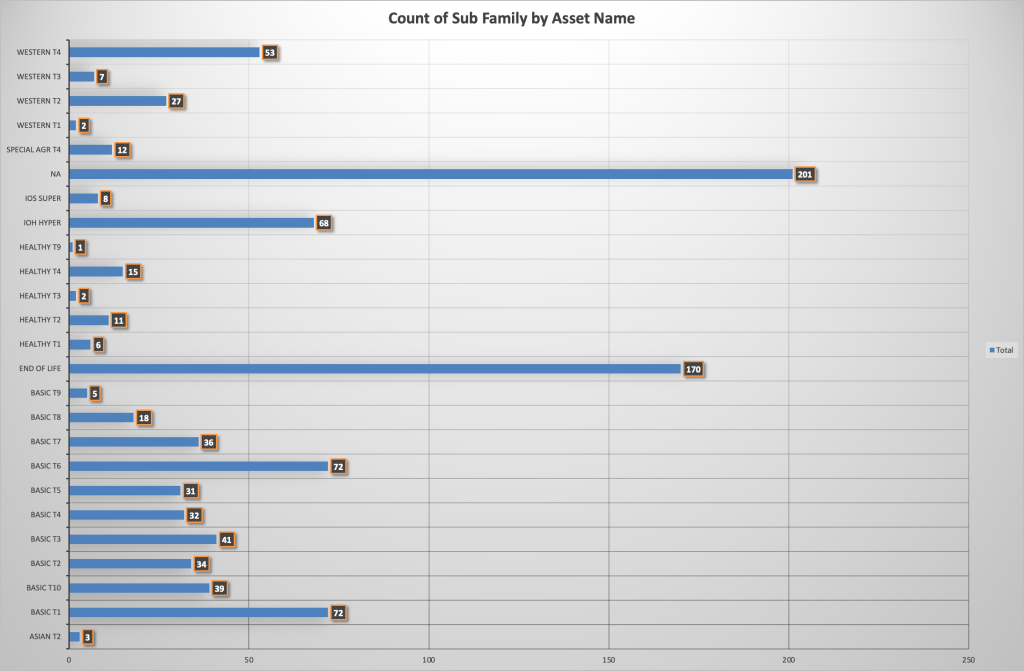
Context and Scope:
This analysis examines how sub-families are distributed across different asset types within the baby food category. Instead of looking at sales or value, the focus here is on assortment structure and asset deployment—specifically, which asset types are being used to carry sub-family assortment and how evenly (or unevenly) that coverage is distributed.
Insights
- Assortment is heavily skewed toward “Basic” asset types
The most dominant insight from the chart is that the assortment is heavily concentrated in “Basic” asset tiers.
Multiple Basic asset types (labelled across tiers such as Basic T1–T10) collectively dominate the count of sub-family records. No single Basic tier overwhelmingly dominates on its own; instead, the aggregate presence of Basic assets drives the overall skew.
This suggests:
- The category relies primarily on standard, non-differentiated fixtures or shelf assets
- Assortment visibility and execution are driven by baseline merchandising rather than premium or specialised assets
- Asset strategy prioritises coverage and availability over differentiation
While this may support scale and consistency, it also limits the retailer’s ability to:
- Signal quality or value differentiation
- Tailor execution to specific infant lifecycle stages
- Leverage assets as a strategic category lever
- Premium and health-led assets are under-represented
In contrast to the dominance of Basic assets, Premium and Health-led asset types appear sparsely represented in the dataset.
Their low sub-family counts suggest:
- Limited deployment of differentiated fixtures
- Underutilisation of assets designed to support premium, organic, or health-positioned propositions
- A category execution model that does not strongly emphasise premium storytelling or stage-specific nutrition
This is particularly notable given the nature of baby food, where:
- Trust, quality, and health cues are highly influential
- Parents often seek reassurance through visual and contextual signals
- Premium and health-led positioning can justify higher value capture
The lack of such assets implies missed opportunities for category differentiation.
- A significant share of records fall under NA / Not Found asset classifications
One of the most striking findings is the large volume of sub-family records classified as NA / Not Found.
This category alone represents a material share of the total asset count, rivaling or exceeding many explicitly defined asset types.
The analysis clarifies that this is not a commercial or strategic choice, but rather a data quality issue, driven by:
- Gaps in asset name capture at source
- Incomplete or inconsistent asset tagging in upstream systems
- Data extraction and sourcing limitations
During data cleaning, missing or ambiguous asset names were standardised as N/A, inflating this category.
This creates:
- Reduced visibility into true asset deployment
- Inability to reliably link sub-families to physical execution
- Structural blind spots in asset-level analytics
- End-of-Life and Basic assets still represent large portions of the assortment
Beyond Basic assets, End-of-Life (EOL) asset types also show a notably high count of associated sub-families, highlighted in the slide with a count of approximately 170.
This signals:
- A significant number of sub-families tied to assets that are potentially outdated, phasing out, or poorly aligned with current category strategy
- Limited visibility into whether these assets remain appropriate, productive, or value-adding
- Possible lag between category evolution and asset refresh cycles
Combined with the dominance of Basic assets, this reinforces the picture of a category that is:
- Operationally stable
- But strategically conservative in asset evolution
- Overall structural signal: high volume, low differentiation
The combined effect of:
- Heavy Basic asset usage
- Under-representation of premium/health assets
- Large NA classifications
- Significant End-of-Life tagging
points to an assortment structure that prioritises volume coverage over differentiated execution.
This does not necessarily indicate poor performance—but it does highlight latent inefficiencies and missed strategic levers within asset management.
Implications
- Strengthening data capture and governance
The prevalence of NA / Not Found asset classifications is a clear signal of weaknesses in data capture and governance at source.
Key implications include:
- Asset information is not being consistently captured or standardised at the point of creation
- Downstream analytics are constrained by incomplete metadata
- Decision-making based on asset performance or optimisation is inherently limited
Improving asset data governance would:
- Enable more accurate asset classification
- Improve comparability across categories and time
- Support scalable, repeatable insights rather than one-off analyses
Strengthened governance is therefore a foundational requirement, not an optional enhancement.
- Inconsistent tagging limits analytical reliability
Inconsistent or missing asset tagging directly reduces:
- The reliability of analytics
- Confidence in insights
- The ability to link assortment, asset, and performance data
Without consistent tagging:
- Asset rationalisation becomes guesswork
- Investment decisions lack precision
- Performance issues may be misdiagnosed
Improving tagging discipline would materially improve decision quality across category, asset, and inventory management.
- Asset utilisation and category differentiation challenges
The high presence of End-of-Life assets signals inefficiencies in assortment and inventory management.
Specifically:
- EOL assets may continue to consume space and inventory despite declining relevance
- They can drive waste, markdowns, and operational cost
- They reduce clarity around which assets are actively supporting the category
At the same time, the dominance of Basic assets highlights limited differentiation, suggesting that:
- The category relies heavily on core execution rather than experiential or lifecycle-specific merchandising
- Non-core categories may require review to determine whether they deserve differentiated assets or rationalisation
- Need for stronger core execution and selective review of non-core assets
The implications point toward a two-track response:
- Strengthen execution in core assets
- Ensure Basic assets are optimised, correctly allocated, and supported by accurate data
- Improve visibility and performance tracking
- Review non-core and End-of-Life assets
- Assess whether they remain strategically justified
- Rationalise or refresh where appropriate
- Reduce waste and cost leakage
This approach balances operational realism with strategic discipline.
Overall Takeaway:
The “Count of Sub-Family by Asset Name” analysis reveals that while the baby food category is broadly supported by standard assets, it suffers from:
- Limited differentiation
- Incomplete asset data
- Structural inefficiencies linked to End-of-Life tagging
Addressing these issues through stronger data governance, clearer asset classification, and more deliberate asset strategy would unlock more accurate insights, better assortment execution, and improved lifecycle alignment over time.
Comparison between Purchase & Quantity Sold: Insights & Implications
Context and Scope:
This analysis compares purchase volumes against actual quantities sold at the item level within the baby food category. The purpose is to assess how well procurement decisions align with realised consumer demand and to identify structural mismatches that increase inventory risk, waste, and working capital exposure.
The chart is explicitly filtered in descending order by Purchase volume, allowing a clear view of how the most heavily purchased items perform relative to their sales throughput.
Insights
- Over-purchasing is evident among the top items
The most immediate insight is a consistent gap between purchase quantities and quantities sold, particularly among the highest-purchased items.
Across the leading SKUs:
- Purchase volumes materially exceed sales volumes
- The gap widens as purchase rank increases
- High purchasing does not consistently translate into proportional sell-through
This indicates systemic over-purchasing, rather than isolated forecasting errors. The issue is not limited to fringe or low-importance SKUs; it is visible among items that receive the highest procurement priority.
- Demand is concentrated, but purchasing is broadly spread
A second key insight is the mismatch between demand concentration and purchasing breadth.
- Sales demand is concentrated in a relatively small number of items, which show comparatively stronger sell-through.
- Purchasing, however, is spread across a much wider range of items, including those with weaker sales performance.
This suggests that:
- The assortment is intentionally broad
- Procurement decisions are not sufficiently weighted toward demand concentration
- Lower-selling items continue to receive substantial purchase volumes
Examples highlighted in the slide (such as cereals and fruit-based products) show stronger relative sales, yet purchase volumes remain elevated even for items with clearly weaker demand signals.
- Mashmeals & Soups show the largest purchase–sale gaps
Among all sub-families, Mashmeals & Soups exhibit the most pronounced misalignment between purchase and sales quantities.
This sub-family:
- Features multiple items with high purchase volumes
- Shows relatively weak sales performance by comparison
- Displays the widest gaps between inventory inflow and consumer outflow
This pattern strongly suggests:
- Overestimation of demand
- Slower turnover
- Elevated risk of ageing stock, markdowns, or waste
The magnitude of these gaps positions Mashmeals & Soups as a primary driver of inventory inefficiency within the category.
- Fruit Jars & Desserts perform relatively better—but inefficiency remains
In contrast, Fruit Jars & Desserts demonstrate closer alignment between purchase and quantity sold.
Key observations include:
- Smaller gaps relative to Mashmeals & Soups
- Better demand responsiveness
- More predictable sell-through patterns
However, the analysis is clear that over-purchasing is still present, even in this better-performing sub-family. While the inefficiency is less severe, it remains structurally embedded in the procurement approach.
In other words, Fruit Jars & Desserts are less misaligned, not fully aligned.
- Structural pattern: optionality over precision
Taken together, the insights point to a procurement philosophy that prioritises optionality and breadth over tight demand matching.
The system appears designed to:
- Maintain wide assortment coverage
- Support multiple brands and product types
- Preserve flexibility in a sensitive, regulated category
However, this comes at the cost of:
- Higher inventory exposure
- Slower inventory turns
- Increased working capital lock-in
Implications
- Problem: Misalignment between purchasing and realised demand
High purchase volumes combined with relatively low quantities sold indicate a clear misalignment between ordering decisions and actual consumer demand.
This misalignment manifests as:
- Excess inventory
- Slower sell-through
- Increased risk of expiry or markdown
Importantly, this is not a short-term anomaly but a structural issue.
- Reason: Deliberate diversification and optionality
The root cause is not poor execution, but rather a deliberate strategy.
The category reflects:
- A mix of established brands and emerging players
- Intentional diversification to maintain breadth
- A desire to preserve choice, continuity, and supplier optionality
This approach is particularly common in baby food, where:
- Supply security is critical
- Consumer trust is sensitive
- Switching costs can be high
However, the strategy prioritises coverage over precision.
- Consequence: Inventory risk and working capital exposure
When diversification is not actively managed, it leads to:
- Unmanaged inventory build-up
- Elevated working capital exposure
- Higher risk in low-selling items
The burden falls disproportionately on:
- Slow-moving SKUs
- Sub-families with weaker demand signals
- Items that receive procurement support without corresponding sales traction
This creates structural inefficiency, even if overall category performance appears stable.
- Solution: Smarter supplier collaboration and flexible procurement
The recommended solution is not to reduce assortment indiscriminately, but to adopt smarter, more flexible procurement models.
Key elements include:
- Stronger collaboration with suppliers
- More flexible contract structures
- Procurement focus on core demand drivers
- Selective growth rather than uniform expansion
This allows the retailer to:
- Preserve strategic breadth
- Reduce inventory risk
- Align purchasing more closely with actual demand patterns
- Outcome: Smart portfolio diversification
The intended outcome is smart portfolio diversification, not contraction.
This means:
- Diversification that is aligned to demand signals
- Reduced inventory and capital risk
- Improved capital efficiency
- Better balance between optionality and precision
The final callout reinforces this message clearly:
“SMART PORTFOLIO DIVERSIFICATION”—not aggressive rationalisation, but disciplined alignment.
Overall Takeaway:
The Purchase vs Quantity Sold analysis shows that the baby food category is intentionally diversified, but insufficiently demand-led at the point of procurement. While this supports resilience and choice, it also introduces material inventory and capital inefficiencies—particularly in lower-selling sub-families such as Mashmeals & Soups.
A shift toward demand-aligned purchasing, flexible supplier arrangements, and selective growth would preserve category resilience while materially improving operational efficiency.
Main Implications
Implication 1: Future of Baby Food
The analysis points to a clear, phased trajectory for the baby food category rather than an immediate need for aggressive diversification.
A. Sales and Supplier Concentration (Current State)
At present, Infant Formula and Flours & Cereals dominate both sales value and supplier portfolios. These sub-families act as the structural backbone of the category, reflecting established infant feeding habits, regulatory frameworks, and retailer merchandising priorities. Supplier strategies are heavily oriented toward these segments, reinforcing their dominance through deeper assortments, stronger availability, and sustained investment.
This concentration is not accidental—it mirrors current consumption patterns, where early-stage infant nutrition remains the most critical and predictable demand driver. As a result, supplier focus, shelf space allocation, and commercial negotiations are disproportionately weighted toward these core sub-families.
B. Medium-Term Strategic Importance
Looking ahead over the medium term, Infant Formula and Flours & Cereals are expected to remain the primary revenue anchors of the category. Their role as dependable volume and value drivers supports continued prioritisation in procurement planning, supplier negotiations, and inventory allocation.
From a strategic perspective, this suggests that protecting and optimising these core segments is essential. Any category strategy that undermines supply stability or margin integrity in these areas would introduce disproportionate risk to overall performance.
C. Preparation for Diversification (Future Readiness)
While current performance justifies concentration, long-term resilience requires preparation. Demographic shifts, evolving parental preferences, increased interest in organic and specialised nutrition, and lifestyle changes are likely to gradually expand demand beyond core sub-families.
Rather than immediate expansion, the implication is for planned, incremental diversification—using data to identify when and where adjacent sub-families begin to show sustained traction. This ensures the category evolves in line with demand signals, without diluting focus or increasing inventory risk prematurely.
Conclusion:
The future of baby food is not about rapid diversification, but about sequenced evolution—anchored today in core nutrition, while being structurally ready for tomorrow’s demand shifts.
Implication 2: Multi-Dimensional Framework
To operationalise this evolution, the analysis supports a multi-dimensional decision framework that balances commercial performance, supply risk, and long-term category development.
A. Framework Foundation
The foundation of this framework is a rebate-led, performance-driven supplier strategy. Negotiations are guided not by uniform pricing pressure, but by category depth, lifecycle relevance, and measurable performance metrics such as sales, profitability, waste, and demand alignment.
This approach recognises that not all sub-families play the same role. Core categories justify deeper partnerships and stability-focused negotiations, while emerging or lower-exposure segments require flexibility and selective experimentation.
B. Scalable Framework
The framework is designed to be scalable, not static. As data quality improves—through stronger governance, better asset tagging, and more reliable ingestion processes—the framework can incorporate additional dimensions such as lifecycle stage coverage, channel performance, and asset utilisation efficiency.
This scalability ensures that decisions remain evidence-led, allowing the retailer to move from descriptive analysis to predictive and prescriptive insights over time.
C. Anchored Preparation for Diversification
Crucially, diversification within this framework is anchored to the infant feeding lifecycle. High-performing sub-families continue to receive priority, while less-penetrated categories are introduced gradually, guided by demand signals rather than assortment ambition alone.
This creates a disciplined path where future growth is captured without destabilising the core—integrating new categories only when they demonstrate both commercial viability and strategic fit.
Conclusion:
Together, these implications reinforce a single overarching message:
The optimal baby food strategy balances concentration with readiness—protecting today’s revenue anchors while building the analytical and operational capability to diversify intelligently over time.
This is not a static category strategy, but a living framework—one that evolves with consumer behaviour, supplier dynamics, and data maturity, ensuring sustainable growth and reduced commercial risk.
Supplementary Implication
Beyond commercial performance and category structure, the analysis highlights transparency as a critical enabling factor for the future of the baby food category.
As demographic shifts continue and parental awareness increases, there is a growing emphasis on nutritional integrity, ingredient clarity, safety standards, and product provenance. Parents are no longer only evaluating baby food on price or availability; they are increasingly driven by trust, quality assurance, and confidence in how products are sourced, processed, and managed across the supply chain.
This heightened focus reinforces the importance of robust QA/QC (Quality Assurance and Quality Control) processes, particularly in categories linked to early-stage infant nutrition. Effective QA/QC is not only a regulatory requirement, but a strategic differentiator—directly influencing brand credibility, repeat purchase behaviour, and long-term category loyalty.
From an operational perspective, transparency is closely tied to data quality and governance. Accurate asset classification, consistent tagging, and reliable ingestion of supplier and product data enable retailers to:
- Track product lifecycle stages more effectively
- Identify risk areas related to expiry, waste, and compliance
- Support informed decision-making across inventory and category management
When supported by the Multi-Dimensional Framework, improved transparency becomes scalable rather than manual. Strong data foundations allow QA/QC insights, supplier performance metrics, and category risks to be evaluated holistically rather than in isolation.
Strategic Value
In practice, this means transparency acts as a force multiplier:
- It strengthens inventory control by reducing uncertainty
- It enhances category planning by aligning products with lifecycle needs
- It supports regulatory readiness and consumer trust simultaneously
Ultimately, increased transparency enables more resilient and responsible growth—ensuring that category expansion, diversification, and optimisation occur without compromising safety, quality, or consumer confidence.
Contact Innovvay for expert feasibility study services in UAE and across GCC