
It’s 10:30 a.m. on a construction site in Dubai.
The structural work is progressing well, but suddenly the MEP contractor raises a concern. The HVAC duct cannot pass through the beam shown in the drawings. Everyone checks the drawings again architectural, structural, and MEP. All look correct. Yet, on site, things don’t fit.
Meetings follow. Emails fly. A redesign is requested. Work slows down. Costs rise.
If you’ve worked in construction long enough, this situation probably sounds very familiar.
This is where the discussion of BIM vs 2D really matters. In today’s fast-moving UAE construction market, accuracy, coordination, and risk control are no longer “nice to have”—they are essential.
Let’s break down what BIM really offers compared to traditional 2D drawings, and why more UAE projects are moving in this direction.
Understanding BIM and 2D Drawings in Simple Terms
Traditional 2D drawings show buildings as flat plans, sections, and elevations. Each discipline architectural, structural, and MEP works on its own set of drawings. Coordination depends heavily on experience, manual checking, and interpretation.
Traditional 2D drawings include:
- Floor plans
- Sections
- Elevations
- Details drawn separately
They show the project from flat viewpoints. Teams must interpret how everything fits together in real life.
BIM, on the other hand, creates a single intelligent 3D model where all systems exist together. Walls, beams, ducts, pipes, and cables are modelled in real space. Every element carries information such as size, material, and function. Tools like Autodesk Revit and Navisworks Manage allow teams to coordinate, analyse, and test designs before construction starts.
- Architecture, structure, and MEP are connected
- Every element carries data (size, material, cost, performance)
- Changes update automatically across the model
Tools like Autodesk Revit and Navisworks Manage make this possible.
The difference is not just visual—it changes how projects are planned, reviewed, and executed.
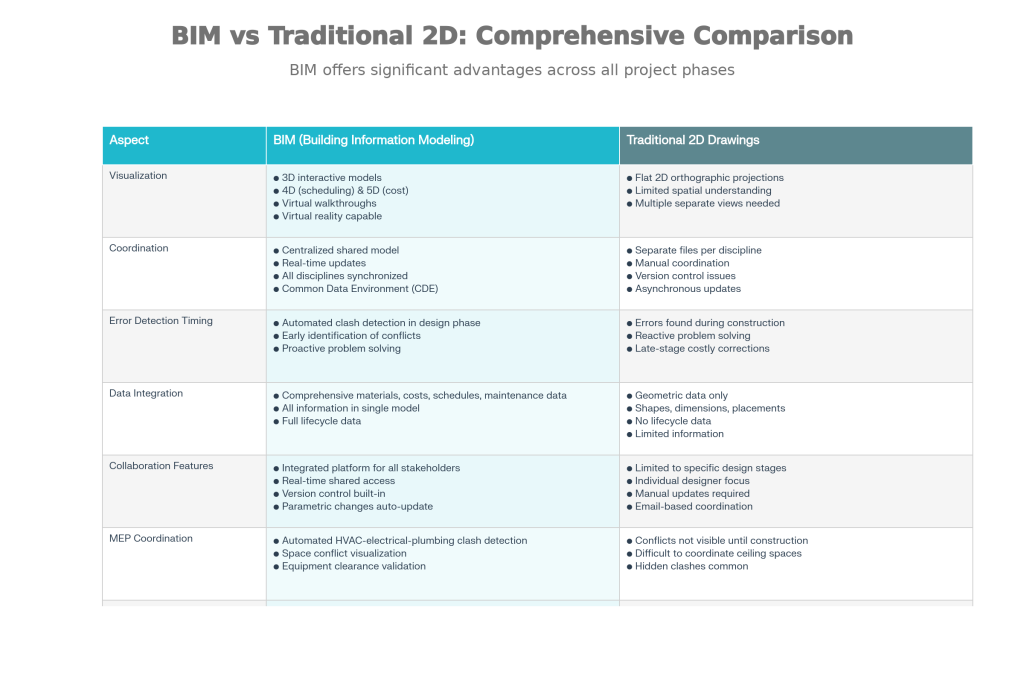
Accuracy: Why BIM Reduces Errors at the Source
In traditional 2D workflows, accuracy depends on manual updates. When one drawing changes, several others must be revised. Under time pressure, small mismatches are common. These inconsistencies often remain hidden until construction begins.
With 2D drawings:
- Different disciplines work on separate files
- Changes must be updated manually in many drawings
- Small mismatches are easy to miss
Even experienced teams can overlook conflicts when reviewing hundreds of drawings under time pressure.
BIM improves accuracy because everything is connected. When a wall moves, attached elements such as slabs, ducts, and finishes adjust automatically. Dimensions, quantities, and locations stay consistent across the model. This reduces the chance of outdated or conflicting information reaching the site.
BIM works like a live system, not static drawings.
Key advantages:
- All disciplines work on coordinated models
- If a wall moves, connected services adjust automatically
- Dimensions and quantities are always consistent
In simple terms, BIM reduces human guesswork.
For UAE projects where designs are complex and tolerances are tight this level of accuracy is critical.
- Tall towers
- Complex façades
- Dense MEP systems
- Tight design and construction timelines
In such environments, small inaccuracies quickly become expensive problems. BIM helps catch them early before construction starts and can helps teams detect issues early, when they are still easy and inexpensive to fix.
Coordination: Where BIM Clearly Outperforms 2D
Coordination is the biggest weakness of 2D drawings. Teams must mentally imagine how systems overlap in three-dimensional space. Even experienced professionals can miss conflicts when reviewing hundreds of drawings.
In traditional workflows, coordination depends on:
- Visual checking
- Experience
- Meetings and markups
Common issues include:
- Ducts crossing beams
- Pipes clashing with cable trays
- Equipment installed without access clearance
- Maintenance zones ignored
Most of these problems are discovered on site, not on paper.
BIM changes this completely by allowing all disciplines to work in one coordinated environment. Structural elements, HVAC ducts, electrical trays, and plumbing systems are modelled together. Conflicts are no longer theoretical they are visible.
What this means:
- The software checks thousands of elements in minutes
- Hard clashes (physical overlaps) are flagged
- Soft clashes (clearance issues) are identified
- Access and maintenance zones are reviewed
Instead of discovering problems during installation, teams resolve them during design.
Using clash detection tools, BIM software automatically identifies where systems overlap, where clearance rules are violated, and where access for maintenance is blocked. Instead of discovering these problems on site, teams resolve them during design coordination meetings.
This shift alone explains why many contractors see BIM as a risk-reduction tool rather than just a design method.
Risk Reduction: From Firefighting to Planning Ahead
Traditional 2D drawings often lead to reactive problem-solving. Issues are discovered during construction, when time and options are limited. Solutions at this stage usually involve extra cost, rushed decisions, and compromised quality.
Traditional 2D Is Reactive
With 2D drawings, risk management usually happens after problems appear:
- Site delays
- Emergency redesigns
- Budget overruns
- Schedule extensions
At that stage, choices are limited and expensive.
BIM supports a proactive approach. Teams can simulate construction sequences, review high-risk areas, and test design alternatives before any physical work begins. This allows risks to be managed early rather than reacted to later.
BIM allows teams to:
- Simulate construction sequences (4D)
- Identify safety risks before site work
- Test design options without physical cost
- Review complex areas virtually
This proactive approach reduces uncertainty and improves decision-making.
Safety and Compliance Benefits
Using BIM, teams can:
- Plan safer construction sequences
- Check clearance and access requirements
- Review compliance digitally before approvals
In the UAE, where project timelines are aggressive and penalties for delays are high, proactive risk management can be the difference between a successful project and a stressful one.
Cost Control: Understanding Financial Impact Earlier
With 2D drawings, cost estimation is largely manual. Quantities are measured separately, and any design change requires rework. As a result, cost impacts are often understood late in the process.
Cost Challenges with 2D
In traditional workflows:
- Quantity take-offs are manual
- Changes require re-measuring
- Cost impact is known late
This leads to budget surprises.
BIM introduces a stronger link between design and cost. Quantities are generated directly from the model, and changes update automatically. This allows project teams to see the financial impact of design decisions early, rather than after construction has started.
BIM supports 5D cost integration:
- Quantities update automatically
- Design changes reflect instantly in cost
- Better forecasting and budgeting
For developers and project managers, this improved visibility supports better budgeting, fewer surprises, and stronger financial control throughout the project lifecycle.
Time Management: Keeping Projects on Schedule
Traditional schedules are usually prepared separately from drawings. While the timeline may look good on paper, constructability issues often appear later and disrupt progress.
Schedules are often created separately from drawings:
- Gantt charts disconnected from design
- Constructability issues discovered late
- Delays cascade across trades
BIM allows schedules to be linked directly to the 3D model, creating what is known as 4D planning. This helps teams visualise how the project will be built step by step. Sequence clashes, access problems, and unrealistic timelines become visible early.
With BIM:
- Construction tasks link directly to the model
- Teams can visualize each construction stage
- Sequence conflicts become visible early
This leads to:
- Better planning
- Fewer surprises
- Shorter project timelines
For fast-track UAE projects, this improved planning leads to smoother execution and fewer delays between trades.
Communication: Helping Everyone See the Same Picture
Not all stakeholders can easily understand technical drawings. Clients, authorities, and non-technical decision-makers may struggle to visualise spaces from 2D plans alone.
The 2D Communication Gap
Not everyone can read technical drawings easily:
- Clients
- Authorities
- Non-technical stakeholders
Misunderstandings often lead to late changes.
BIM improves communication by showing the project in 3D. Stakeholders can walk through spaces virtually, understand layouts clearly, and provide feedback earlier. This reduces misunderstandings and late-stage changes.
With BIM:
- Stakeholders see the project in 3D
- Walkthroughs explain design intent clearly
- Feedback improves early in the process
This reduces confusion and improves trust between teams.Clear communication also builds trust something that is especially valuable in large, multi-stakeholder UAE projects.
Addressing Common Concerns About BIM
“BIM Is Only for Big Projects”
While BIM is essential for large projects, even medium-sized developments benefit from:
- Better coordination
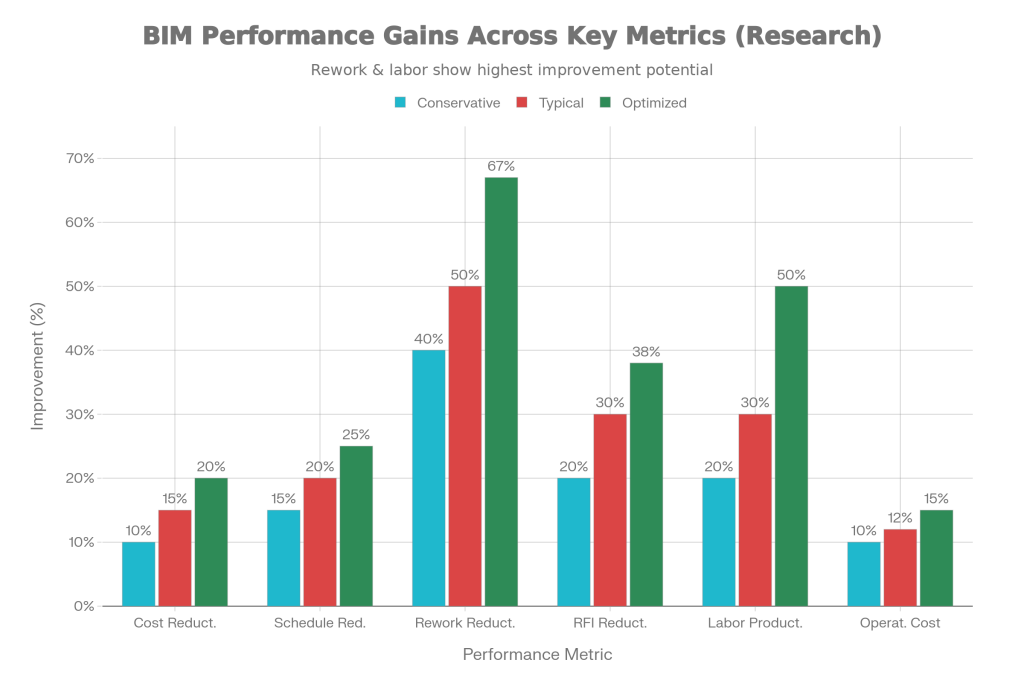
- Reduced rework
- Clear documentation
“BIM Is Too Expensive”
BIM requires upfront investment, but:
- Rework reduction saves money
- Faster delivery improves cash flow
- Lifecycle savings add long-term value
“2D Is Enough If the Team Is Experienced”
Experience helps, but:
- Even expert teams are human
- BIM supports experience with automation and data
- The combination delivers better results
Some professionals believe BIM is only suitable for very large projects. In reality, even medium-sized developments benefit from improved coordination and reduced rework.
Others worry about cost. While BIM does require upfront investment in software and training, these costs are often offset by savings from fewer errors, faster delivery, and better long-term building performance.
There is also a belief that experienced teams do not need BIM. Experience is valuable, but BIM supports experience with automation and data, reducing reliance on memory and manual checks.
When Traditional 2D Still Works
Traditional 2D drawings may still be practical for small, simple projects with limited services and low risk. Renovations with minimal design changes can also work well with 2D documentation.
Traditional 2D drawings may still be suitable for:
- Small, simple buildings
- Minor renovations
- Projects with very limited budgets
- Low MEP complexity
However, as complexity increases, so does risk. In those cases, BIM provides clear advantages.
What UAE Projects Need Today
The UAE construction market is known for ambition, complexity, and speed. High-rise buildings, mixed-use developments, and infrastructure projects demand precision and coordination.
- Ambitious designs
- Complex geometry
- Tight deadlines
- High-quality expectations
In this context, BIM is no longer optional. It supports better accuracy, stronger coordination, and effective risk control. The gap between BIM-based projects and traditional 2D workflows continues to grow.
Conclusion: Making the Right Choice
The bim vs 2d discussion is not about trends it is about outcomes. BIM offers a smarter way to manage today’s construction challenges by reducing errors, improving collaboration, and controlling risk.
BIM delivers:
- Higher accuracy
- Stronger coordination
- Lower risk
- Better cost and time control
For UAE projects facing complexity, scale, and speed, BIM is not a future trend it’s a current requirement.If your upcoming project involves complex coordination, tight schedules, or high financial stakes, relying only on traditional 2D drawings may expose you to unnecessary risk.Now is the time to consider BIM and INNOVVAY’s Bim Services for UAE Businesses not as an expense, but as an investment in certainty.